
If there’s one thing I’ve consistently noticed after years of working in early childhood education, it’s this:
The moment someone decides to start a preschool, curriculum suddenly becomes the centre of every conversation.
Initially, most discussions are about:
• the preschool setup,
• interiors,
• admissions,
• branding,
• teacher recruitment,
• preschool franchise opportunities,
• or whether the reading corner should have artificial grass underneath it.
Then, very quickly, the conversation changes.
Someone eventually asks:
“Which curriculum should we follow?”
And honestly, it’s a very fair question.
Because curriculum quietly influences almost everything inside a preschool:
• how children experience learning,
• how teachers interact,
• how classrooms function,
• how parents perceive the school,
• and ultimately, how children begin forming their relationship with education itself.
Over the years, I’ve had the opportunity to observe classrooms, work with preschool founders, train teachers, design curriculum systems, and spend a great deal of time watching how children naturally respond to different learning environments.
And somewhere along the way, I realised something important:
Children do not experience curriculum in the same way adults discuss it.
Adults compare educational philosophies.
Children experience feelings.
They remember:
• whether teachers made them feel emotionally safe,
• whether learning felt exciting,
• whether they were encouraged,
• whether they were allowed to explore,
• and whether school became a place they genuinely looked forward to returning to every morning.
And interestingly, some of the strongest preschool classrooms I’ve seen over the years were never rigidly attached to one philosophy alone.
They borrowed thoughtfully from several.
Why Preschool Curriculum Matters More Than Many People Initially Realise
When people hear the word “curriculum”, they often imagine:
• lesson plans,
• worksheets,
• phonics,
• tracing books,
• alphabets,
• and school-readiness activities.
But in early childhood education, curriculum goes much deeper than academics.
A thoughtfully designed preschool curriculum quietly shapes:
• confidence,
• communication,
• emotional security,
• social interaction,
• independence,
• curiosity,
• creativity,
• problem-solving,
• and a child’s long-term relationship with learning itself.
I still remember visiting a preschool years ago where the classrooms were visually quite simple.
No extravagant interiors.
No oversized branding.
No imported Scandinavian furniture that looked more expensive than most adult dining tables.
But the moment the children entered, the atmosphere changed completely.
Teachers greeted every child individually.
Children moved around comfortably and confidently.
One little boy proudly explained the classroom responsibilities to me as though he had personally overseen school operations for several years.
And I remember thinking:
This school understands children.
That feeling rarely comes from infrastructure alone.
It usually comes from the culture a preschool builds over time — and curriculum plays a very large role in shaping that culture.
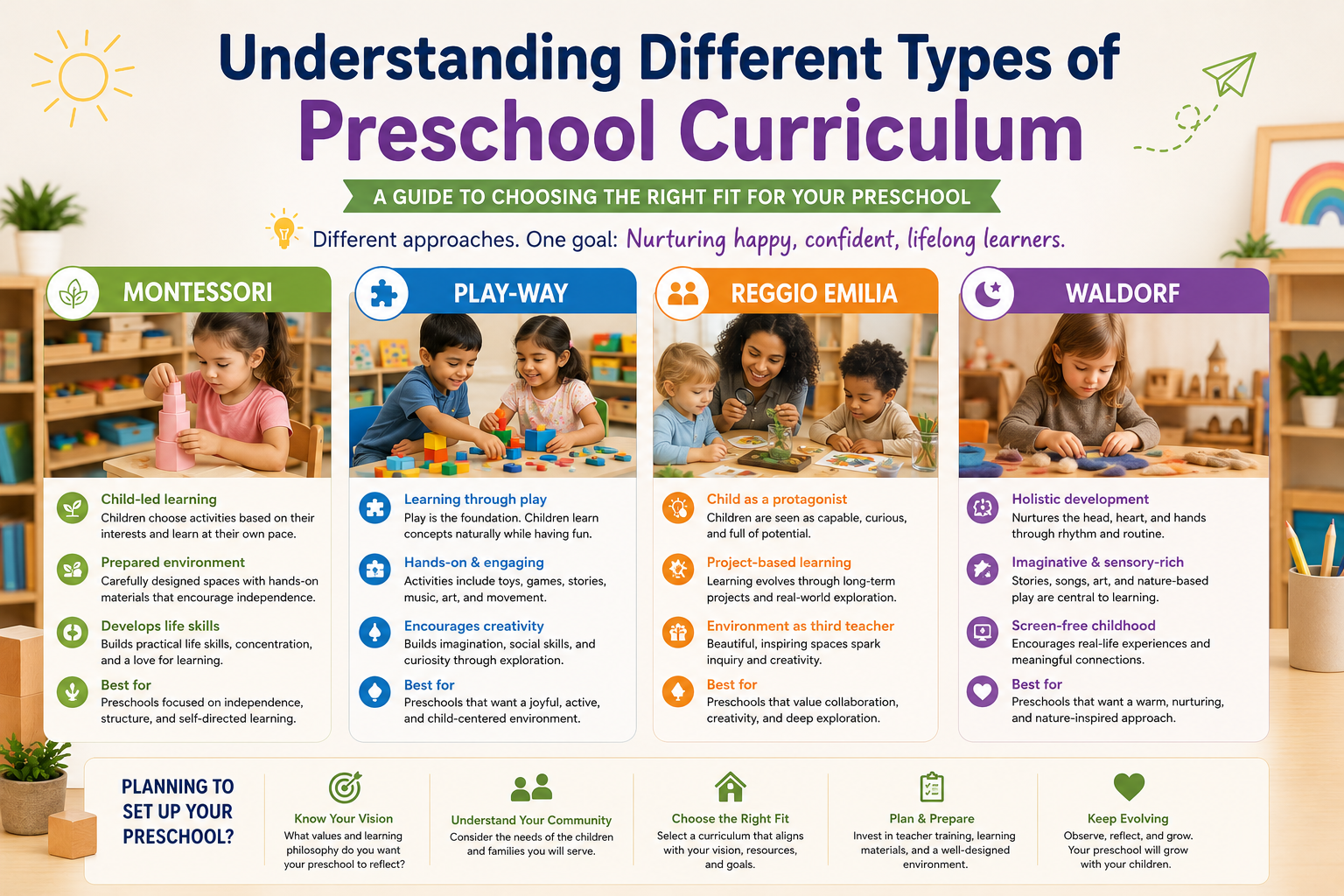
Montessori Curriculum — Calm, Structured, and Quietly Impressive
The Montessori method is probably one of the most recognised preschool curriculum systems worldwide.
And understandably so.
Montessori classrooms often have a very calm and intentional atmosphere.
You’ll usually notice:
• carefully arranged learning materials,
• practical life activities,
• sensory learning tools,
• independent exploration,
• mixed-age interaction,
• and children working with remarkable concentration for their age.
The first time many parents walk into a well-functioning Montessori classroom, they’re genuinely surprised by how capable young children can be when trusted with responsibility.
I still remember watching a four-year-old carefully clean up a spill, return materials independently, and then quietly assist another child — all without adult prompting.
Meanwhile, several adults nearby were still attempting to remember where they had placed their car keys.
That’s one of the things Montessori does beautifully:
it nurtures independence very naturally.
Children are trusted with routines, responsibility, and self-correction from an early age.
And over time, that confidence grows quietly.
Many preschool owners researching Montessori preschool setups are drawn towards this sense of structure, discipline, and calm order.
And honestly, in today’s increasingly overstimulated world, one can understand the appeal.
At the same time, after observing many Montessori-inspired environments, I’ve also noticed that children respond differently to different forms of structure.
Some children thrive in calm, independent spaces almost immediately.
Others take a little longer before they begin engaging confidently.
And that, interestingly, is something that repeatedly appears across almost every curriculum philosophy:
children themselves remain wonderfully unpredictable.
Froebel’s Play-Way Learning — Where Learning Feels Natural Rather Than Forced
The Play-Way method is one of the most widely used preschool curriculum approaches today.
And after spending enough time around young children, the reason becomes fairly obvious.
Children naturally learn through:
• movement,
• music,
• storytelling,
• role play,
• exploration,
• games,
• conversation,
• imitation,
• and interaction.
A child building blocks is not “just playing”.
That child is learning:
• coordination,
• sequencing,
• balance,
• patience,
• communication,
• emotional regulation,
• and problem-solving.
Play-based learning recognises something extremely important:
Young children engage more deeply when they feel emotionally connected to the activity itself.
In strong Play-Way classrooms, learning feels natural rather than heavily instructed.
Children may:
• learn language through storytelling,
• strengthen communication through role play,
• improve numeracy through games,
• develop confidence through interaction,
• and build social skills simply through repeated collaboration.
Some of the happiest preschool environments I’ve seen follow this approach very naturally.
The classrooms feel energetic, conversational, and emotionally relaxed — while still remaining thoughtfully structured underneath.
And interestingly, parents usually notice the difference very quickly.
Children who genuinely enjoy preschool tend to speak about school constantly at home.
Usually during dinner.
Usually while the adults are attempting to have a completely unrelated conversation.
One thing I’ve personally observed over the years is that children often retain concepts more effectively when learning feels experiential rather than instructional.
A child may forget a worksheet surprisingly quickly.
But a child who learned counting while pretending to run a vegetable shop with classmates will probably remember the experience — and the learning attached to it — much longer.
Reggio Emilia — Allowing Curiosity to Lead the Learning Process
The Reggio Emilia philosophy is one of the most fascinating preschool learning approaches because it views children as naturally capable thinkers.
Instead of rigid lesson structures all the time, learning often evolves from children’s observations, questions, and interests.
If children become curious about:
• rain,
• insects,
• shadows,
• leaves,
• construction vehicles,
• plants,
• or even puddles,
…the teachers may build entire learning experiences around those interests.
I once visited a classroom where children had become deeply fascinated by snails after finding one in the school garden.
For nearly one week:
• they observed snail movement,
• drew snail shells,
• listened to stories about creepy crawlies,
• discussed habitats,
• explored spiral patterns,
• and built tiny “homes” for snails using classroom materials.
And honestly, the children were completely absorbed.
That’s the beauty of inquiry-based learning when it is implemented thoughtfully.
Children stop feeling like passive recipients of information and begin participating actively in learning itself.
For many preschool curriculum designers, the Reggio Emilia approach feels refreshing because it respects curiosity instead of constantly trying to control it.
And in many ways, curiosity itself becomes the bridge between learning and emotional engagement.
What’s particularly interesting is how differently children respond when they feel their ideas are genuinely being acknowledged.
Even quieter children often begin participating more confidently when discussions emerge from something they naturally care about.
Waldorf Education — Protecting the Emotional and Imaginative Side of Childhood
The Waldorf approach feels very different from many modern educational environments.
The classrooms often feel:
• warm,
• imaginative,
• sensory-rich,
• calm,
• and emotionally grounded.
Storytelling, movement, rhythm, creativity, music, art, nature, and imaginative play form central parts of the learning experience.
Technology exposure is usually limited during the early years so children can engage more deeply with:
• physical experiences,
• creativity,
• emotional connection,
• and human interaction.
I remember visiting a Waldorf-inspired classroom once where children were fully absorbed in a storytelling activity involving handmade puppets and music.
No screens.
No flashy technology.
No overstimulation.
Just complete attention and imagination.
And what struck me most was how emotionally settled the environment felt.
Not rigid.
Not silent.
Simply calm in a very genuine way.
Many educators appreciate Waldorf learning because it preserves the imaginative and emotional side of childhood that can sometimes get overshadowed when schools become excessively focused on academic outcomes too early.
And honestly, spending time inside these classrooms often becomes a gentle reminder that childhood does not always need to be rushed.
So Which Preschool Curriculum Is Actually Best?
After years of observing classrooms, training teachers, designing curriculum systems, and watching children respond to different learning environments, I’ve honestly come to one consistent conclusion:
No single curriculum is perfect for every child.
Because children themselves are wonderfully different.
Some children thrive in structure.
Some need movement constantly.
Some enjoy independent exploration.
Some learn socially.
Some communicate through art.
Some require emotional reassurance before comfortable learning can begin at all.
And this is exactly why many experienced preschool curriculum designers eventually begin creating learning environments that feel more balanced than rigidly philosophical.
Because in real classrooms, flexibility quietly becomes one of the most valuable educational tools.
Why Many Strong Preschool Classrooms Naturally Blend Multiple Approaches
One of the most interesting things I’ve noticed while observing highly successful preschool environments is that the strongest classrooms rarely feel one-dimensional.
You may walk into a classroom and notice:
• Montessori-inspired independence,
• Play-Way engagement,
• Reggio-style curiosity,
• Waldorf warmth,
• sensory exploration,
• phonics integration,
• movement-based learning,
• and social-emotional development…
…all existing together quite naturally.
And interestingly, most children respond very positively to this kind of balance.
Because children themselves are multidimensional.
A child may:
• learn phonics best through repetition,
• build confidence through role play,
• strengthen motor skills through sensory activities,
• improve communication through storytelling,
• and develop social skills through collaborative play.
One rigid approach may not always accommodate all of those comfortably.
Balanced classrooms often create more room for adaptability without losing educational direction.
And honestly, many modern preschool curriculum systems are already evolving this way — even if schools don’t formally describe themselves using terms like “eclectic curriculum”.
Because experienced educators eventually realise something important:
Children do not learn in one fixed way all the time.
Even the same child may learn differently depending on:
• emotional comfort,
• developmental readiness,
• environment,
• confidence,
• energy levels,
• or simply the kind of morning they had before arriving at school.
And this flexibility becomes increasingly important in modern preschool environments where children arrive with very different personalities, routines, communication styles, and home experiences.
Why Modern Early Childhood Education Increasingly Supports Balanced Learning
Interestingly, modern child development research increasingly supports balanced learning environments during the early years rather than extremely rigid academic systems.
Studies around early childhood education consistently highlight the importance of:
• play,
• movement,
• emotional security,
• social interaction,
• sensory experiences,
• communication,
• creativity,
• and inquiry-based learning.
Children learn most effectively when they feel:
• emotionally safe,
• curious,
• engaged,
• and developmentally ready.
This is one reason many progressive preschool curriculum models today quietly combine multiple educational philosophies instead of relying entirely on one.
Because in practice, balance often produces healthier long-term outcomes than rigidity.
And parents are becoming more aware of this too.
Most families today are not searching for the “strictest” preschool anymore.
They’re looking for:
• emotionally secure classrooms,
• caring teachers,
• balanced learning,
• communication development,
• confidence-building,
• creativity,
• social interaction,
• and genuinely happy children.
And honestly, those outcomes are usually built through thoughtful educational balance rather than extremes.
The Best Curriculum Often Feels Almost Invisible
This is something I’ve personally come to believe over time.
In truly strong preschool classrooms, curriculum itself almost disappears into the environment.
Children are simply engaged in:
• exploring,
• creating,
• communicating,
• questioning,
• moving,
• learning,
• collaborating,
• and feeling emotionally secure.
You don’t constantly “see” the curriculum.
You see confident children.
And ultimately, that is probably one of the strongest indicators that a preschool learning environment is functioning thoughtfully.
Final Thoughts
After years in early childhood education, I’ve come to believe that curriculum matters enormously — but curriculum alone never defines a preschool.
Children remember experiences far more than educational terminology.
They remember:
• whether teachers were kind,
• whether learning felt joyful,
• whether curiosity was encouraged,
• whether they felt emotionally safe,
• and whether school felt like a place where they belonged.
The strongest preschool environments are rarely trying to prove they follow one philosophy perfectly.
Instead, they focus on creating classrooms where:
• children feel secure,
• teachers feel empowered,
• learning feels natural,
• and development happens thoughtfully over time.
Because ultimately, good preschool education is not about choosing between Montessori, Play-Way, Reggio Emilia, or Waldorf as though one philosophy alone contains all the answers.
It’s about understanding children deeply enough to know that learning itself is wonderfully varied, deeply human, and constantly evolving.